Happy Star Wars Day!
May the Fourth be with you!
The “Un” Birthday!
Today is a Holy day for all true adherents of the book of MoF0! Today, fourty five years ago, is the day Facebook thinks Joshua A.C. Newman was born. It is in fact NOT his birthday today, but religious history, and religious myth are one and the same thing. Hundreds of years from now, devout and loyal MoF0s the world over, will be marking this day, and holding week long festivals to commemorate “The Un-Birthday” of the “New-Man.”
The Lockon.
Having just discussed “The List” and my desire to update the rules for adding a frame to the list, I am going to go ahead and add a Frame to “The List” without the aforementioned discussion. The reason for this is that the Frame in question has been accepted by the community in a way that goes beyond whatever rules revision we may come up with. The frame I speak of is Vitor Faria’s Lockon frame. Copies of the Lockon have popped up on the hanger, the facebook group, and most notably the Flickr group. A quick search on the MFZ Flickr group will give you a great return. Now a few of the returns will not be Lockons, but that in no way diminishes the rest of what you will get. Here are a few of the inner frame pictures that Vitor has gifted the community.
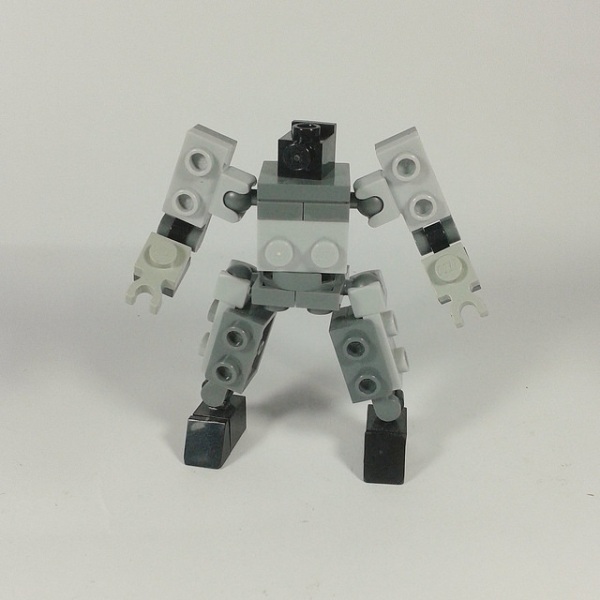
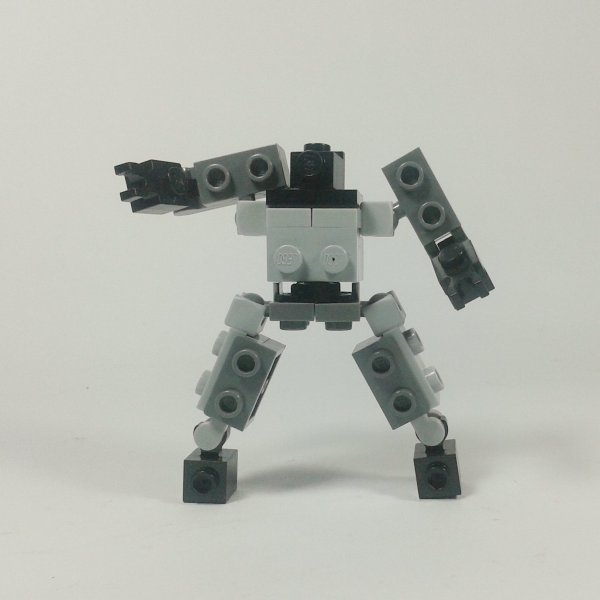
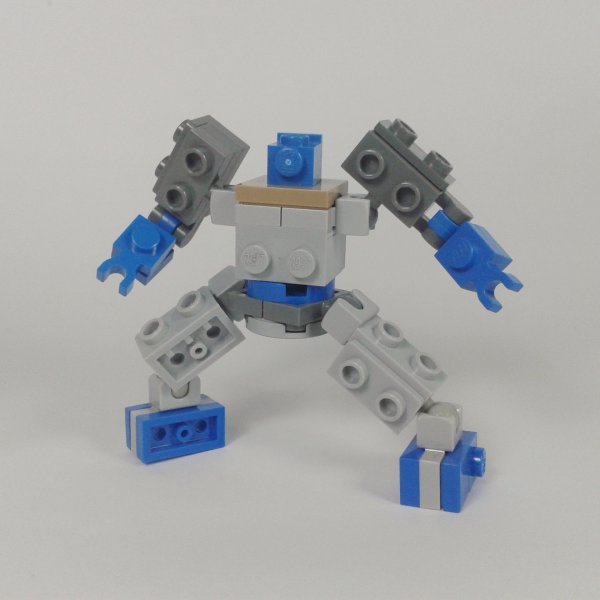

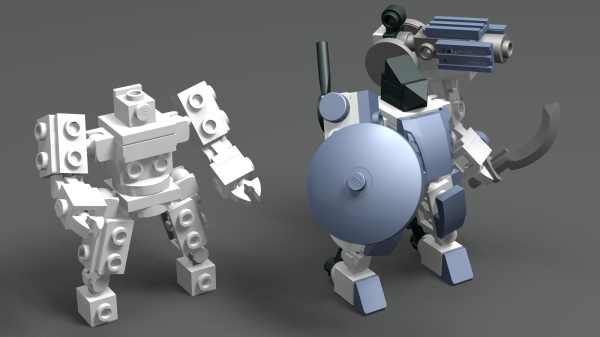
Here is a great render by Captain Foo that clearly shows the difference between a complete mech and the inner frame. Great pic.
Another thing I like is that many who have adopted the Lockon are not guilty of being members of the cult of the lone build. Here is a squad of three by Mika Metsatahti.

And another.
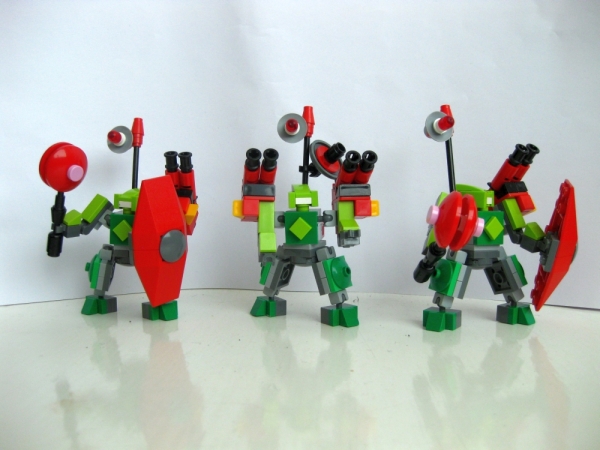
Here is an entire company of Lockons and Lockon mods in green and black by Mark Sakura.

Mark Sakura was so inspired by the Lockon, that he has come up with Two variants he calls the Deadlock, and the Grimlock, as well as minor variations on those as well.
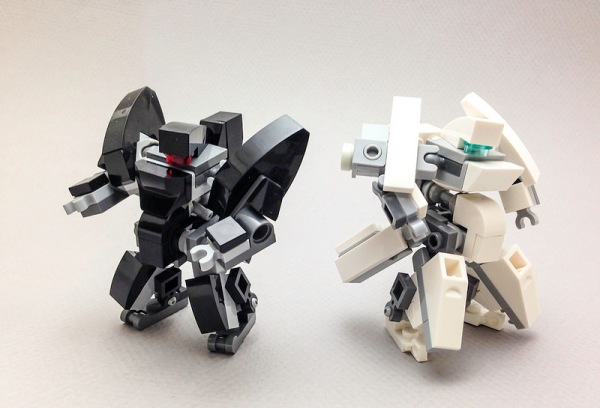
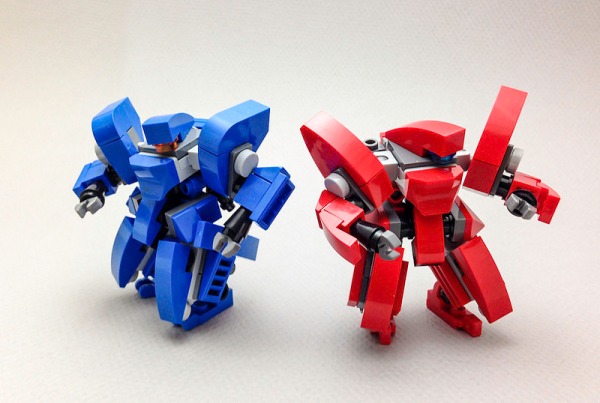
Fellow MFZ Blogger Raymond Bull AKA Mantisking said “The Lockon has truly entered the DNA of the Mobile Frame community.” If that is not a resounding commendation, then I don’t know what is!
The List.
I would like to start a public discussion about “The List of Frames.” Even though I have not posted for two and a half years, the “List” still gets a good amount of traffic. My personally imposed rules for what I could and could not put on the list have become more and more stringent as the size of the community has increased. At first I would add a frame if I found one person (other than myself) who had copied a frame. Then the number became two, and then three. Now I am not sure what the requirement should be. I also find myself putting into question the rule about anything made or discussed by one of the games contributors. I may reduce that to just what makes it into published material, but I want public feedback on that before I proceed. I no longer think of the list as belonging to me. It belongs to the community, so I want the communities help in determining its future.
Scale vs. Size
Scale and Size, are closely related terms that are often confused with each other in regards to playing or discussing Mobile Frame Zero. If you are six foot tall, and someone scans you and prints out a statuette of the scan at two feet tall, then that statuette is a one third scale model of you. If they print out the scan at one foot tall, then it would be a one sixth scale model of you. The scale of the statuette is one sixth because it would take six of them to equal the height of the source material, in this case you. The “size” of the one sixth scale model is one foot, or twelve inches.
Within the Mobile Frame Zero community it has become agreed upon through common usage that the “scale” of a game played will not be given a number based on fractional relationships to real world objects but a number based on how many Lego plates it takes to equal six feet. When I first started talking about scale, I found the average height of an adult man is five feet and ten inches. I figured with the addition of combat boots and a helmet the “average” man would then be an even six foot tall.
The Rule book has a background universe in which ground combat is based on a “seven plate scale” standard, but the rules and mechanics are not tied to any one scale. As long as the game pieces fit within the “suggestion box” and the ruler is the same length, then the game plays the same, no matter what the scale of the terrain. My preferred scale for game play is five plate scale, although I do have three different forces in seven plate scale.
If you have the space for bigger games you can increase the size of the “suggestion box” and the length of the ruler. The game will play the same. It will just require more space to play. The same is true in the other direction. If you have less space to play, you can reduce the size of the “suggestion box” and shorten up the ruler.
Not Dead Yet!
Hello again. It has been a little more than two and a half years since I posted on this blog, and the topics that I wish to discuss have stacked up a bit.
The first three things I want to talk about are terms used by our community, scale vs. size, and the evolution of the “List.”
Our community is a combination of Anime Fans, Lego Fans, Robot Fans, and Gamers. Our community also uses terminology that came to us from all those source communities, and several sub-set communities. Anime fans use the term “Mecha” to describe robots that are piloted or not. Fans of Battletech and Mech-Warrior call the robots in their games “Mechs.” Many games, manga, and anime have different names for the robots they contain: Gear, Bot, Trooper, Armor, Exo suit, Exo Armor, Landmate , Hard suit, and many more. From the beginning the original Mechaton referred to “Giant Fighty Robots,” and “Mechs.”
Eight years ago this month, I started “The list of Frames.” I got the term “Frame” from the Lego community, specifically the Lego Mecha community. Finding Mechaton online in 2002 had brought me back to Lego, but I had not stopped there. I did delve heavily into the Lego Mecha community for several years, and still keep tabs on it to this day. The Lego Mecha community does not use the term frame as a replacement for mech, mecha or robot. The term Frame is used to describe the internal structure and method of construction of the model. It was not uncommon for a builder to build a mecha model, photograph it, strip the outer layers of Lego off of the “Frame,” and then build another model over the same inner Skeletal “Frame.” Many builders would photograph the naked frame itself as a way of helping new builders learn the art of building mechs themselves.
This was my reasoning behind starting the list of frames. It was one way of making the game more accessible to the world at large as well as keeping a record of what was popular in the community over the years. Two and a half years later when Joshua decided to reboot Mechaton as Mobile Frame Zero, he used the term Frame to replace Mech. Frame is a good alternative to Mech, and part of me likes to think my use of the term in “The List” was an influence in his decision to do so. Everyone likes to think they have had an influence on the shape of the world, no matter how small. Another part of me wishes he had picked another name, because his use of “Frame” as a name for the robots has blurred the definition of my use of the term “frame” to describe the “method of construction” of the robots.
My list was intended to highlight different ways of building mechs of an appropriate size to be used in the game (and that is part of the topic of my next post). The list was not about the final appearance of the mechs, or the prettiest or coolest mechs, but the inner “Frame” of the mechs that had proven “popular” in the community.
The “MASSIVE Compilation of Frame Instructions” is out!
Fellow MoF0 Scrape has put together two very large book format downloads of instructions for frames. He has tried to list credit for the original frame design as well as any previous frames that the design borrows from, and credit to the people that put the instructions together.

These are a huge resource for the Mobile Frame community.
You can download the Frame compilation here.
You can download the NEOAEZ collection here.
You can read the announcement here.
You can read the original thread here.
This was a very big project. Thank you Scrape for putting this all together, and thank you to everyone who had a hand in contributing to this project.
Happy Star Wars Day!
May the fourth be with you!
Adding to “The List.”
I have been absent for more than a year and have neglected both this blog and the list. There are three frames being added to the list today, and a quick look through the MFZ Flikr group will prove just how deserving all three of these are of being added. The first is The Land mate by Malcom Craig. The land mate has been copied more than any other non “Canon” frame with the possible exception of the MGN, which as fate would have it is also on the list, and also a creation of Malcom’s. That says a great deal about Malcom’s creative power.

The second frame being added today is a much more recent creation, but in the half year since it was first posted to the Flickr group it has been copied numerous times. The frame is half Landmate and Half Conscript. The frames creator Greg Strom has dubbed it the Landscript, and the name is just as popular as the frame itself.

The third and final frame being added today is a modification of Soren’s iconic Chub frame. The frame I speak of is of course the “Super Chub” by Josh Shimko. Not only has this frame been copied many times but it has lent parts of itself to a multitude of other frames by numerous builders, and has been blamed by some as having singlehandedly started the “Cult of Articulation” within the MFZ community.

Alpha Bandit Scale!
Long time readers of this blog will know that scale is a subject that is very important to me. Scale becomes even more important when playing a game that involves the players building their forces from bricks. The size of items on the game table in relation to each other is one factor in how we judge the tactical situation. For this reason it helps when all parties involved are building to the same scale, or set of “scale rules.” Joshua has set size limits for the ships, saying that in this game “the biggest cruiser is about 120 meters long.” He also sets the size limit when built in the brick at sixteen studs, and the size limit of the frigates is set at twelve studs. So with this in mind I made a quick size comparison with a few ships that most of us are familiar with. The Romulan bird of prey is 131 meters long. The Klingon bird of prey is 109 meters long. The Boeing 747 is 70 meters. The Serenity is 63 meters. The Millenium Falcon is 26.7 meters. The sixteen stud brick is 120 meters, and the twelve stud brick is about 90 meters.
Thanks to Jeff Russell’s Starship Dimensions website for the images and size information.


 No B.S. Just A.B.S.